The Magic of Holding the World in Your Hands
There’s something almost spellbinding about a globe. You spin it and watch the continents blur into color, oceans shimmer in soft blues, and imaginary lines of latitude and longitude slice across the sphere like invisible threads binding our planet together. A globe isn’t just a decorative object or a classroom relic—it’s one of humanity’s oldest and most poetic tools for understanding the Earth. It represents exploration, curiosity, and our endless desire to make sense of the world around us. But what exactly is a globe? Beyond being a miniature Earth, it’s a time capsule of human progress, a teaching device, a work of art, and, in many ways, a symbol of how we see ourselves in relation to our planet. Let’s take a spin through the story of globes—their meaning, origins, evolution, and why they still matter in the age of Google Maps.
The Definition: More Than Just a Sphere
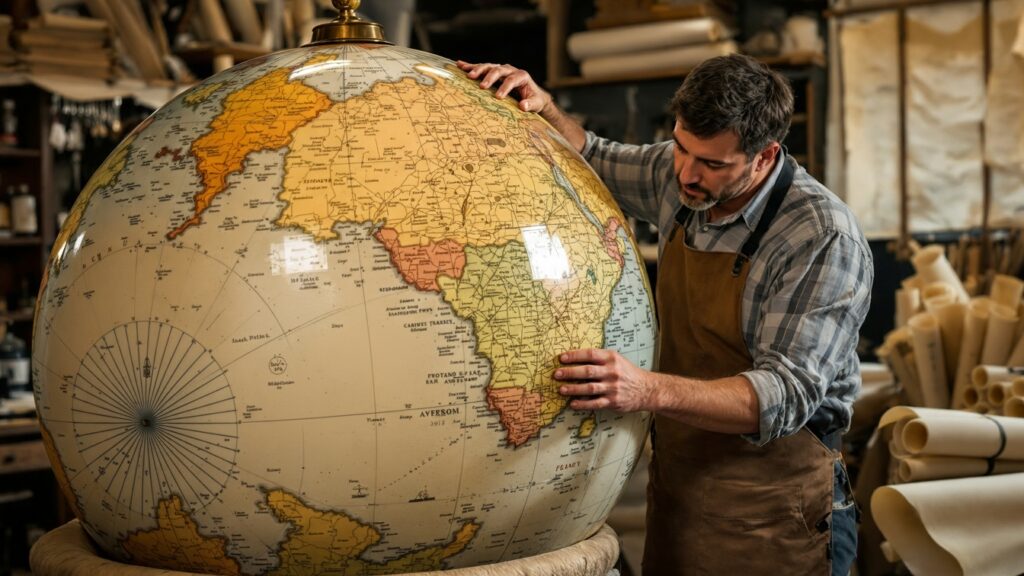
At its simplest, a globe is a spherical model of Earth (or another celestial body, like the Moon or Mars). Unlike flat maps, a globe accurately represents distances, shapes, and directions, avoiding the distortions that come from flattening a round planet onto a two-dimensional surface. When you look at a globe, the continents are in their true proportions, the poles aren’t stretched, and the equator maintains its rightful curve. In essence, a globe is geography made tangible. It’s Earth as it truly is—round, tilted, spinning, and dynamic. And that small tilt of about 23.5 degrees you see on a stand-mounted globe? That’s not for style—it mirrors the actual tilt of our planet’s axis, the reason we experience seasons and varying daylight throughout the year.
The Origins: Ancient Minds, Modern Dreams
The idea of modeling Earth as a sphere dates back thousands of years. The ancient Greeks were among the first to propose that the Earth was round—an astonishing revelation at the time. As early as the 6th century BCE, philosophers like Pythagoras and later Aristotle noticed how ships disappeared hull-first over the horizon and how Earth’s shadow curved on the Moon during lunar eclipses.
These early observations inspired thinkers to imagine the world as a globe long before one had ever been built. Around 150 BCE, the scholar Crates of Mallus is believed to have constructed the first known globe in ancient Greece. His model wasn’t just a piece of art—it was a bold scientific statement that challenged the flat-Earth beliefs still lingering in other cultures.
From there, the concept of a globe slowly spread. Islamic scholars in the Middle Ages refined the art of celestial globes to chart stars and navigation routes, while Renaissance mapmakers in Europe would later perfect terrestrial globes as exploration reshaped the world’s known geography.
The Renaissance of Exploration and Mapping
When the Age of Exploration dawned in the 15th and 16th centuries, globes became more than curiosities—they became essential tools for understanding a rapidly expanding world.
In 1492, Martin Behaim of Nuremberg created what is considered the oldest surviving terrestrial globe, the Erdapfel (German for “Earth Apple”). Made before Columbus returned from his first voyage, Behaim’s globe lacked the Americas entirely but showcased the best geographical knowledge available to Europeans at the time.
Just decades later, the explosion of global exploration transformed these early models. New continents appeared. Sea routes expanded. Nations raced to map and claim unknown lands. Globes evolved alongside this discovery frenzy, reflecting not only geography but also the power, pride, and politics of the age.
By the 17th and 18th centuries, no aristocratic study or university hall was complete without an elegant pair of globes—one terrestrial, one celestial—mounted on polished stands. They were both scientific instruments and status symbols, representing the educated man’s reach for worldly and cosmic understanding.
Anatomy of a Globe: The Art Behind the Sphere
What makes a globe so special isn’t just its accuracy—it’s its craftsmanship. Building a globe requires precision, geometry, and artistry.
The process starts with the sphere itself, traditionally made from wood, metal, or papier-mâché, and today often molded from durable plastics. Over this spherical surface, What is a globe?—wedge-shaped printed map segments—are carefully pasted. Each gore represents a slice of Earth’s surface, perfectly curved to fit without wrinkles or gaps.
These gores are a feat of mathematical design. The map projection used to print them compensates for the curvature of the sphere, ensuring that once applied, every continent and ocean lines up correctly. Finally, the globe is mounted on an axis, tilted at the same 23.5-degree angle as Earth, and placed within a meridian ring or frame that allows it to spin freely.
Modern globes often include illumination, relief features to show mountain ranges, or transparent outer layers to highlight ocean currents and political boundaries. Whether made for education or decoration, each globe reflects the craftsmanship of those who dare to recreate the entire planet in miniature form.
Globes vs. Maps: The Eternal Debate
Why bother with a globe when a flat map can hang neatly on a wall? The answer lies in accuracy—and philosophy. Every map projection, no matter how clever, distorts reality. Flattening Earth means stretching, compressing, or tearing parts of it to make it fit. That’s why Greenland looks enormous on a Mercator projection (when in reality it’s much smaller than Africa), and why the poles often appear exaggerated. A globe eliminates this problem. It presents distances, shapes, and relative positions exactly as they are. You can trace the shortest route between cities, follow the true curve of the equator, and see how the continents connect across the oceans. A map may be practical, but a globe is pure truth in three dimensions. It captures what makes our planet unique—its roundness, its rotation, its sense of continuity. Spinning a globe connects you to the rhythm of Earth itself, something a flat surface simply can’t convey.
The Globe in Education: The Classroom Icon
For generations, globes have been the centerpiece of classrooms, inspiring curiosity in young minds. There’s something tactile about running your fingers over mountain ridges or tracing imaginary voyages across the Pacific. Unlike digital maps, a globe invites exploration through touch and wonder.
Teachers have long used globes to explain concepts like time zones, climate zones, and international borders. They help students visualize how day and night happen simultaneously around the world or how long it takes to fly from one continent to another. In an era of screens and satellite images, globes remain a uniquely human learning tool—a blend of science and art that encourages discovery.
Today’s educational globes often integrate technology. Some models connect with augmented reality (AR) apps, projecting interactive data on ecosystems, cultures, or global events when scanned with a smartphone. Others illuminate the Earth’s internal layers or historical changes, helping children and adults alike see our planet not just as geography but as a living, evolving system.
The Many Types of Globes
Not all globes are created equal. While the classic terrestrial globe represents Earth, there’s an entire universe of variations:
- Celestial globes show constellations and the night sky as seen from Earth, a tradition dating back to ancient astronomers.
- Lunar and planetary globes depict other worlds, such as the Moon, Mars, or Venus—perfect for astronomy enthusiasts or space agencies.
- Political globes highlight countries and borders, while
- physical globes emphasize natural features like mountain ranges, rivers, and deserts.
- There are antique reproduction globes, cherished by collectors for their historical charm.
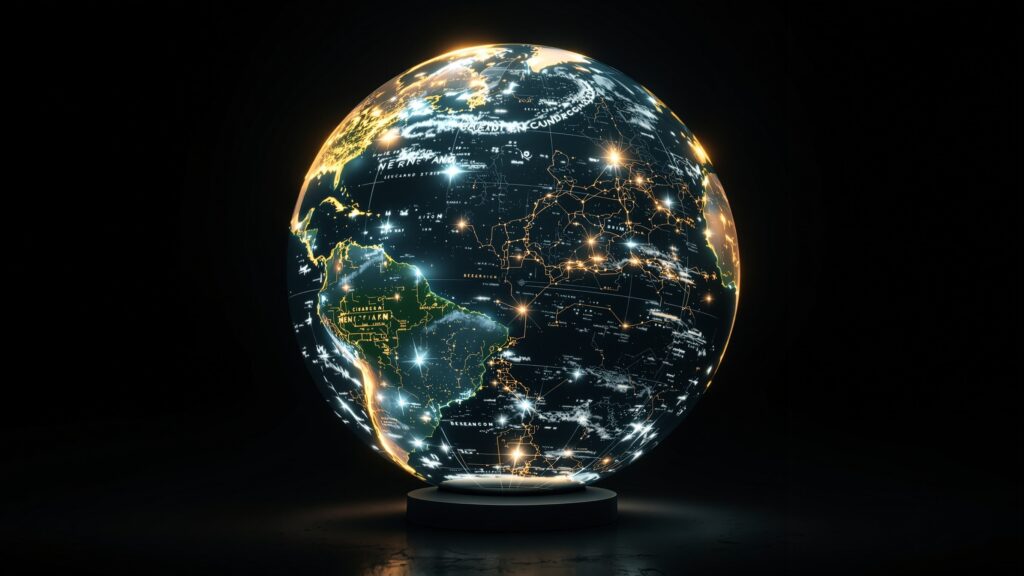
- Interactive digital globes, which project satellite imagery and weather patterns in real-time.
Whether made for a scholar’s desk, a student’s study nook, or a designer’s office, every type of globe offers a different way to see and interpret our world.
The Symbolism of the Globe: Humanity’s Collective Mirror
Beyond science and geography, the globe holds deep symbolic meaning. It represents unity, exploration, and perspective. When we look at a globe, we’re reminded that every border is human-made and every nation, no matter how large or small, shares the same fragile sphere hurtling through space. In art and literature, the globe often symbolizes ambition and discovery. Explorers of the past traced its contours in search of trade routes; visionaries of today spin it while dreaming of sustainability, peace, or even interplanetary travel. To hold a globe is to grasp a miniature version of everything humanity has ever known—every mountain, city, and ocean—all existing in balance. It’s a humbling and empowering image at once.
From Libraries to Living Rooms: The Globe as Decor
In modern homes and offices, globes have transcended their purely educational purpose to become design icons. A globe on a desk evokes intellect, curiosity, and wanderlust. Designers craft them in vintage brass, minimalist chrome, reclaimed wood, or even transparent acrylic, turning geography into an aesthetic statement.
Antique-style globes with sepia tones and hand-drawn lines bring a touch of nostalgia, reminiscent of exploration’s golden age. Meanwhile, illuminated globes cast a soft glow that doubles as both nightlight and conversation piece. Some even incorporate bar storage—an homage to mid-century design where geography and luxury intertwined.
No matter the style, a globe adds character to a space. It signals that the person who owns it values knowledge, beauty, and the spirit of adventure.
The Digital Revolution: From Paper to Pixels
With the rise of digital mapping and tools like Google Earth, one might assume physical globes are obsolete. After all, we can now zoom from the Great Wall of China to the Grand Canyon in seconds, or explore the ocean floor from our phones. Yet paradoxically, globes are thriving. Their enduring popularity lies in what technology can’t replace—the emotional connection of holding the world in your hands. A screen gives information; a globe gives perspective.
Moreover, digital innovation has enhanced the globe’s purpose. Today’s high-tech versions can display real-time weather systems, population data, and even social trends through projection mapping. Scientists use 3D Earth models to simulate climate change scenarios, while educators merge physical globes with digital overlays to create immersive learning experiences. The globe, far from being outdated, has evolved into a bridge between the tangible and the virtual.
Famous Globes That Changed the World
A few globes in history have left an indelible mark on culture and science. Among them is the Erdapfel, Behaim’s pioneering 1492 creation, which offered a snapshot of pre-Columbian geography. Another is The Hunt–Lenox Globe (circa 1510), one of the earliest to include the phrase “Hic Sunt Dracones” (“Here Be Dragons”), a warning of unknown territories. Then there’s Coronelli’s Venetian Globes from the 1680s—massive, meticulously hand-painted spheres nearly four feet across that graced royal palaces and reflected a world both known and imagined. In the modern era, monumental installations like the Unisphere in New York, built for the 1964 World’s Fair, continue the tradition—symbolizing global unity and technological progress. Each globe, no matter its scale, tells a story about how humans have seen their place in the cosmos at that moment in history.
The Globe and the Human Spirit of Exploration
The globe isn’t just a tool for understanding geography—it’s a metaphor for our endless curiosity. Every spin is an invitation to ask: What’s over there? Who lives there? What makes that region unique?
In classrooms, it inspires the next generation of travelers and scientists. In museums, it preserves our collective curiosity about the unknown. In homes, it reminds us that while the world feels vast, it’s also intimately connected.
This spirit of exploration has driven humanity to cross oceans, scale mountains, and now explore space. When astronauts first saw Earth from orbit—a glowing blue sphere floating in darkness—they described it with awe. Their words echoed the very feeling you get when you spin a globe: the sense of fragility, beauty, and shared destiny that defines our planet.

Crafting the Perfect Globe for You
Choosing a globe today can be as personal as choosing art. Some prefer classic political globes with bright colors and crisp country outlines. Others gravitate toward antique finishes that capture the romance of old cartography. Modern enthusiasts might opt for smart globes that connect to Wi-Fi and update with live data or showcase night and day illumination. There are even giant floor-standing models that command attention, perfect for libraries or offices, and small desktop globes ideal for cozy nooks or study spaces. The right globe reflects your relationship with the world—whether you see it as a place to explore, protect, or simply admire.
Why Globes Still Matter
In a time of digital overload, where maps fit in our pockets and satellite images flood our screens, the globe’s simplicity feels refreshing. It slows you down. It invites you to wonder. It encourages you to see the big picture—literally. Globes remind us that the Earth isn’t divided by our differences, but united by its shape. They offer context for everything: where we live, how we connect, and how small we are in the vastness of space. They also teach humility. Looking at a globe, you realize that the distance between continents isn’t just physical—it’s historical, cultural, and emotional. Every spin brings a new realization about the delicate balance that keeps our planet alive.
The Future of the Globe: From Earth to the Stars
As humanity reaches for Mars, Europa, and beyond, globes are expanding their domain. NASA has already commissioned globes of the Moon and Mars based on high-resolution data. One day, classrooms may feature globes of exoplanets, modeled from telescope data—new worlds that remind us how special our own is.
In a way, the globe has come full circle. From Crates of Mallus’s first attempt at a spherical Earth to interactive 3D models of the universe, our desire to visualize the cosmos hasn’t changed—it’s simply evolved with our reach. The future of globes isn’t confined to geography; it’s about perspective. As we continue to explore, the globe will remain a symbol of both where we’ve been and where we’re headed.
Spinning Toward Understanding
So, what is a globe? It’s more than a sphere. It’s a storyteller, a teacher, a time machine, and a piece of art that invites you to see the world as a whole. It’s a bridge between curiosity and understanding—a reminder that our planet, with all its chaos and beauty, is one interconnected home. Whether you find one in a classroom, a library, or your own living room, take a moment to give it a spin. Watch the continents glide past your fingertips. Trace your dreams from pole to pole. Because within that single turn lies the essence of what makes us human—the desire to explore, to learn, and to see our world from every possible angle.