
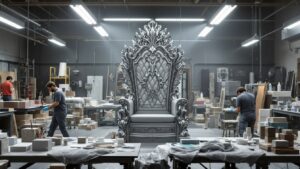
The Seat of Power – Reimagined
Few pieces of furniture carry as much symbolic weight as a throne. From ancient empires to modern movie sets, the throne has always represented power, prestige, and personality. But in the world of design and fabrication today, the word “throne” has taken on a wildly creative new meaning. Custom thrones are no longer limited to gilded royal chairs behind palace doors — they’ve become imaginative centerpieces for weddings, fantasy photo ops, theme parks, VIP lounges, cosplay conventions, and even brand activations. Whether it’s a crystal-studded queen’s seat for a bridal stage or a twelve-foot dragon-winged prop for a comic expo, custom thrones blur the line between furniture and sculpture. They are not just seats; they are statements — of character, of story, of mood. Each one is built to make people feel larger than life.
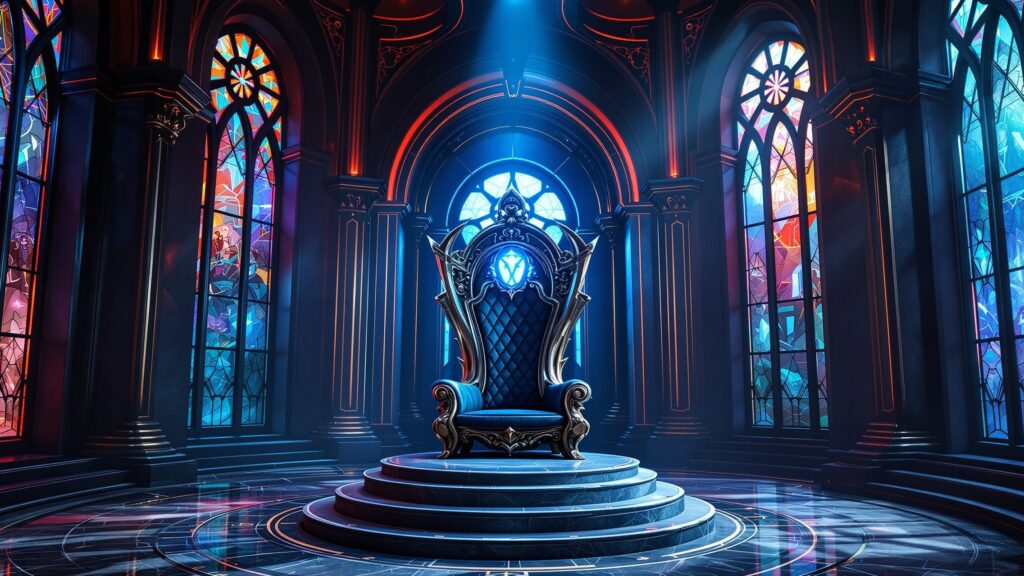
A Brief History of Thrones – and Why They Still Matter
Every culture has had its version of a throne. The Pharaohs of Egypt ruled from carved stone seats inlaid with gold and lapis lazuli. The Greeks and Romans used marble and bronze, often raised on platforms to elevate their rulers above the crowd. Medieval kings sat in towering wooden chairs decorated with heraldic crests and velvet cushions. But the power of the throne has always extended beyond politics. It’s psychological. To sit higher, centered, and ornamented is to occupy the visual heart of a room. The throne directs attention and demands respect. Today’s custom thrones reinterpret that timeless impulse. Instead of crowns and scepters, the context might be LED lights, logos, or cinematic fantasy motifs — but the goal remains the same: to create an unforgettable focal point. Whether for an event, exhibit, or themed installation, the modern throne carries centuries of visual storytelling in every curve and carving.
Where You’ll Find Custom Thrones Today
Modern thrones appear in far more places than palaces. They’re used in entertainment, business, retail, and art. In film and television, a custom throne instantly sets tone and hierarchy — think of the difference between a villain’s spiked iron chair and a serene elven seat carved from luminous “wood.” Production designers rely on throne builds to project authority, fantasy, or humor in a single image.
Event designers use thrones as high-impact focal points. A luxury wedding might feature a snow-white tufted pair of “king and queen” chairs for the couple. A video game launch might include a metallic cyberpunk seat with glowing blue circuitry for fans to pose in.
Theme parks and museums commission custom thrones for immersive environments — allowing visitors to “sit like a Pharaoh” or “take the captain’s chair.” Even corporate and retail settings have adopted them: a beauty brand might place an oversized pink throne in a flagship store as an Instagram-ready backdrop. Essentially, wherever people gather and cameras roll, the custom throne is there — part furniture, part storytelling prop, part marketing genius.
The Anatomy of a Custom Throne
A well-designed throne balances comfort, form, and spectacle. It must look powerful while still supporting real use. Designers think in layers — structure, silhouette, texture, and finish. At its heart is the frame. This is where scale and durability are decided. Depending on purpose, the frame might be wood, steel, aluminum, or high-density foam reinforced with internal supports.
The silhouette comes next — the outline that defines the chair’s personality. Straight-backed Gothic? Winged and serpentine? Floating and futuristic? This is where artists sketch bold ideas that will later drive fabrication. Texture and finish bring the magic. A throne can be smooth and mirror-like, or rough and ancient. Faux gold leaf, gemstones, crystal acrylics, leather, or sculpted foam vines — the possibilities are nearly endless. And finally, the seat: where the user actually interacts with the art. Comfort padding, upholstery, and human-scale ergonomics are essential. No matter how dramatic the shape, a good custom throne must still feel like a seat worthy of lingering in.
The Creative Process – From Sketch to Spectacle
The journey of a custom throne begins with imagination. Clients typically start with a theme — royal, fantasy, sci-fi, angelic, infernal, fairy-tale, or branded. Designers translate that theme into concept sketches or 3D models, exploring proportion, ornamentation, and surface materials. Once a design direction is approved, the fabrication process begins.
The throne may be digitally modeled using CAD or sculpting software like ZBrush or Blender. This allows exact sizing for human interaction and visual impact. Many fabricators also use 3D printing or CNC foam cutting to rough out major shapes with precision.
Then the real artistry begins. Large pieces are hand-carved or sanded to refine the contours. Seam lines are sealed, layers are reinforced, and textures are applied. The throne takes shape slowly, evolving from a raw skeleton into a fully realized piece of art. Throughout, the designer balances practical concerns — weight, stability, portability — with the visual demands of grandeur. Some thrones must be lightweight enough for event transport; others are built permanently into themed environments.
Materials Fit for Royalty – and Modern Fabrication
Today’s throne makers have an incredible range of materials at their disposal, each with its own benefits.
- Wood remains a classic — easy to carve, strong, and rich in texture. For historical replicas or warm, traditional looks, hardwood frames with stain or gold leaf are timeless.
- Foam and fiberglass open entirely new creative worlds. EPS or XPS foam can be CNC-cut or sculpted into elaborate fantasy shapes, then hard-coated with polyurethane or polyurea for a durable shell. These methods allow towering, lightweight builds that look massive but can still be moved easily.
- Fiberglass and resin composites create glossy, ultra-smooth surfaces perfect for futuristic or sculptural designs.
- Metal thrones — made from steel or aluminum — deliver a sense of permanence and weight, often chosen for industrial, sci-fi, or gothic aesthetics.
- Upholstery materials bring the tactile luxury: velvet, leather, crushed velour, brocade, or faux fur. Lighting and multimedia can also be integrated — embedded LEDs, sound triggers, or motion sensors that make the throne come alive.
How Custom Thrones Are Fabricated – Step by Step
Building a throne is like merging furniture design, sculpture, and theater set construction. Here’s how a typical large-scale build might unfold:
Step 1. Concept and Scaling
Everything starts with the vision and measurements. Designers scale the throne according to its purpose — a small event seat might be 4–5 feet tall, while a grand statement piece could reach 10 feet or more. CAD drawings ensure accurate proportions.
Step 2. Frame Construction
The internal skeleton is built first. For wooden frames, carpenters assemble structural panels and joinery for stability. For foam-core thrones, technicians cut blocks of EPS foam and glue them into rough shapes around a lightweight metal or PVC frame.
Step 3. Sculpting and Detailing
Artists sculpt the throne’s ornamentation by hand or with CNC routers. Scrolls, wings, claws, crests, or geometric patterns emerge through careful carving and sanding.
Step 4. Hard Coating and Reinforcement
To ensure durability, the foam is coated with polyurea, epoxy, or fiberglass. This creates a tough shell that can withstand handling and outdoor display. Reinforcement rods or internal bracing may be added for structural integrity.
Step 5. Surface Finishing and Painting
After sanding and priming, scenic artists paint the throne. Metallic finishes, aging washes, faux wood grains, or marble effects bring realism. Some thrones receive gold or silver leaf, rhinestones, or 3D-printed embellishments.
Step 6. Upholstery and Assembly
Cushions, padding, and textiles are installed last. Decorative studs, trim, and hardware complete the look. The final assembly is inspected for comfort, stability, and visual perfection.
Step 7. Delivery and Installation
Depending on the client’s needs, the throne might ship as one piece or in modular sections. Installers set it up on site, often adding lighting, props, or staging to complete the environment.
The entire process can take anywhere from a few weeks to several months, depending on complexity and finish level. The result? A show-stopping centerpiece that commands attention the moment it’s unveiled.
The Art of Scale – Bigger Than Life
Custom thrones often play with exaggerated scale. A throne that’s slightly oversized makes anyone sitting in it look regal; a giant throne can make adults feel childlike and amazed. Scale manipulation is one of the most powerful psychological tools in design.
For photo booths and attractions, fabricators often build thrones twice or three times human scale. These giant seats invite playful interaction — guests climb, pose, and laugh. A larger-than-life throne is inherently shareable content, perfect for social media. Conversely, some designers use scale subtly: taller backs, broader arms, thicker legs. Even small increases in dimension subconsciously signal authority and importance. This is why directors and photographers instinctively frame their subjects from slightly below when they sit on a throne — it enhances presence.
Thrones Across Genres – From Fantasy to Futurism
What makes custom thrones so exciting is their stylistic diversity. They aren’t confined to one look or era.
- Fantasy Thrones evoke the worlds of myth and legend. Think dragons, crystal towers, forest spirits, and glowing runes. Materials like sculpted foam, LED crystals, and metallic paints make these feel alive.
- Medieval Thrones lean on dark woods, ornate carvings, and fabric richness — perfect for reenactments, themed restaurants, or castle attractions.
- Sci-Fi Thrones use geometric or asymmetrical forms, smooth fiberglass, and embedded lighting to suggest advanced technology or alien civilization.
- Nature-Inspired Thrones incorporate organic forms — vines, leaves, waves, even antlers. They’re popular for weddings, garden exhibits, and eco-themed installations.
- Pop-Culture Thrones borrow from iconic media imagery: superhero insignias, fantasy emblems, or cultural mashups. They transform recognizable motifs into immersive experiences.
Every custom throne becomes a personality: regal, menacing, serene, playful, or cosmic. And that’s precisely what makes them irresistible to designers and audiences alike.
From Palaces to Parties – The New Age of Event Thrones
In today’s event landscape, a throne is more than décor; it’s an activation. Guests are drawn to it like a magnet. They photograph it, post it, tag it — and in doing so, spread the brand or event’s identity across the digital world.
That’s why thrones appear everywhere: red-carpet photo stations, influencer lounges, nightclubs, quinceañeras, Halloween displays, product launches, and trade shows. Event planners often commission throne packages that match specific color palettes or brand tones. A fashion label might opt for a sleek chrome throne; a fantasy festival might choose something glowing and moss-covered. Some are even designed to travel, with modular legs and lightweight foam construction for quick setup.
The versatility of the throne — both as furniture and storytelling device — makes it a design element that never fades from popularity.
When a Chair Becomes a Sculpture
What truly distinguishes a custom throne from ordinary furniture is its sculptural intent. A throne doesn’t simply fit in a room; it defines it.
Fabricators treat each project as an artwork. They experiment with asymmetry, negative space, layered materials, and theatrical lighting. They think in cinematic terms: how the throne looks from every angle, how shadows play across its surfaces, and how it frames the person sitting in it. In many ways, a throne build is a fusion of architecture and performance design. It must stand up to physical use yet maintain the aura of fantasy. That dual purpose — function and illusion — is what makes custom thrones so fascinating to create.
Commissioning a Custom Throne – The Creative Collaboration
Ordering a custom throne is as much about storytelling as it is about furniture. Clients often begin with a mood board or concept phrase — “regal but modern,” “ancient forest queen,” “industrial angel,” “cosmic overlord.” Designers then interpret those words into shapes, materials, and finishes. The process involves constant collaboration: sketch reviews, material samples, color tests, and prototype mockups. For themed entertainment or film clients, digital renderings allow approval of scale and visual style before fabrication begins.
Because each throne is one-of-a-kind, costs vary widely. Small photo-op thrones may start in the low thousands, while large scenic builds or permanent installations can range into the tens of thousands, depending on complexity, materials, and finish quality. But the result is always unique — a centerpiece no one else has, designed specifically for one environment and one story.
Why We’re Still Fascinated by Thrones
There’s something universal about the allure of a throne. It taps into deep human instincts — to be seen, to be celebrated, to belong to something larger than ourselves. Sitting on a throne, even playfully, shifts our posture and self-perception. It’s no longer just about rest; it’s about transformation. Suddenly you’re the ruler, the hero, the guest of honor. That’s why thrones persist across cultures, eras, and mediums. Whether carved from stone or fabricated from foam, they remind us of imagination’s power to elevate the everyday. A throne is more than a seat — it’s an experience.
The Future of Custom Thrones
As digital design, 3D printing, and mixed materials evolve, throne fabrication is entering a new golden age. Artists can now simulate metal, wood, or stone using lightweight composites. Embedded lighting, holographic effects, and AR overlays turn thrones into interactive installations. Sustainability is also shaping the field. Eco-friendly foams, recycled resins, and water-based coatings are increasingly used. Some studios even design thrones for disassembly, allowing components to be reused for new productions — a modern twist on royal upcycling. In a world hungry for spectacle and shareable moments, custom thrones aren’t going away. They’re getting smarter, greener, and more cinematic than ever.
The Throne as an Invitation
At its core, a custom throne invites participation. It says, “Come sit here and imagine yourself in a different world.” Whether in a wedding hall, museum exhibit, or trade-show booth, it transforms a space into a stage and its visitor into a star. That’s the magic of these creations — they turn audiences into characters, and ordinary settings into kingdoms of wonder. From foam and fiberglass to fabric and fantasy, the custom throne will always hold its place as one of design’s most captivating forms. Because no matter how modern our technology becomes, people will always love the feeling of sitting on something extraordinary — something that says, if only for a moment, this seat is yours.
Check out WhiteClouds’ 3D Props for more information.
Contact us today to learn more about our 3D services and how we can help you achieve your goals.